
If you’ve sourced eco-friendly ramen bowls before, you probably noticed something strange pretty quickly—prices don’t just vary, they swing.
Same size, similar look, both labeled “eco-friendly,” yet one quote is almost double the other. At that point, it stops being about sustainability and starts feeling like guesswork.
What’s actually happening here is simple: different suppliers are defining “eco-friendly” very differently, and unless you break that down, you’re paying for things you may not even need.
It’s Not the Paper — It’s What’s On It
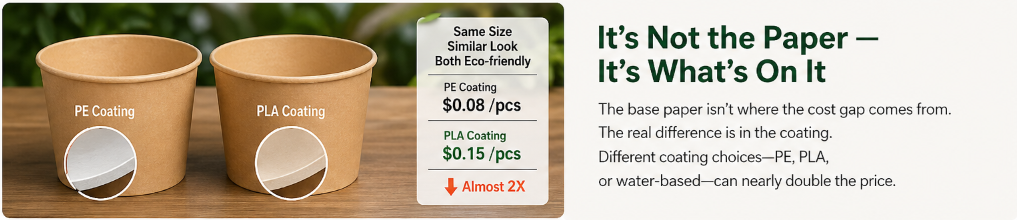
A lot of buyers assume the price jump comes from the paper itself. Kraft must be more expensive, right? Not really.
In most cases, the base paper isn’t where the gap comes from. The real cost difference usually sits in the coating. That inner layer—whether it’s PE, PLA, or something marketed as water-based—changes everything.
Some suppliers, especially a ramen bowl supplier for bulk buyers, will automatically quote a higher-end coating without asking how the product is actually used. From their perspective, it’s safer to offer the “better” option.
From your perspective, that might just mean unnecessary cost.
Certifications Sound Important — Until You Look Closer
Certifications are one of those things that feel non-negotiable at first. Compostable, FSC, biodegradable… they all sound like must-haves.
But here’s the thing: not every business actually needs them.
If your bowls are used for takeaway and end up in general waste, the presence of a compostable certification doesn’t change much in reality. Still, a custom ramen bowl manufacturer for restaurant chains may include it by default, because many buyers don’t question it.
That’s where costs quietly stack up.
It’s worth asking a very direct question: is this certification required for your market, or just “nice to have”?
Low MOQ Isn’t Always a Good Deal
Smaller orders feel safer, especially when testing a product. But with eco-friendly packaging, low volume can get expensive fast.
Production setup, printing plates, material sourcing—these costs don’t scale down linearly. A printed ramen bowl factory for private label brands might give you a reasonable MOQ, but the unit price tells the real story.
Sometimes increasing your order slightly changes the pricing more than you’d expect. Not always convenient, but often worth checking before locking in a small batch.
“Fully Compostable” Doesn’t Always Mean Better
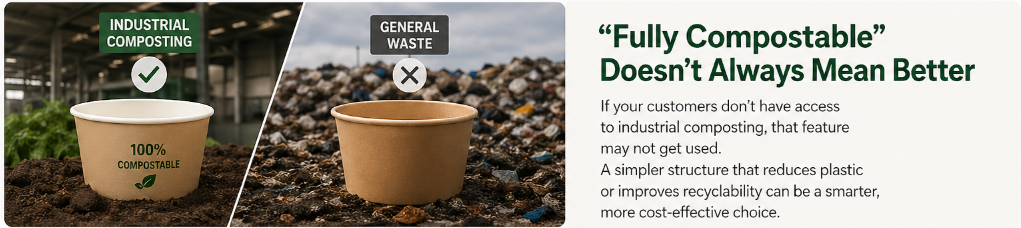
There’s been a shift toward fully compostable products, and on paper, it sounds like the right move.
In reality, it depends.
If your end customers don’t have access to industrial composting, that feature doesn’t really get used. A oem ramen bowl manufacturer for food distributors may position this as the premium option—and technically, it is—but that doesn’t mean it’s the right fit for every situation.
In many cases, a simpler structure that reduces plastic or improves recyclability does the job just fine, without pushing your costs up.
Printing Can Quietly Drive Up the Price
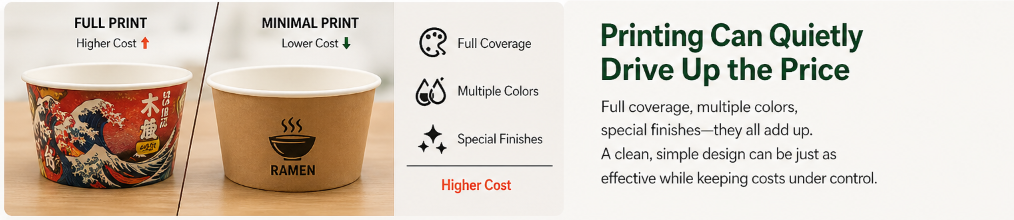
This one catches people off guard.
It’s easy to focus on materials and forget how much printing affects the final cost. Full coverage designs, multiple colors, special finishes—they add up quickly.
A eco ramen bowl manufacturer for quick service restaurants might suggest going all-in on branding, especially if you’re trying to stand out. But not every product needs that level of detail.
Some of the most effective packaging is actually quite minimal. Clean, simple, and cost-efficient.
Comparing Quotes Isn’t as Straightforward as It Looks
On the surface, comparing two quotes should be easy. Same product, pick the better price.
But with ramen bowls, small differences matter.
Thickness, coating type, even subtle structural changes can affect both performance and cost. A reliable ramen bowl factory for global importers should be able to explain exactly what you’re getting.
If that information isn’t clear, you’re not really comparing like-for-like.
And that’s where bad decisions happen.
Don’t Just Ask for a Lower Price — Change the Structure
When a quote feels high, the instinct is to negotiate. That’s normal.
But instead of just asking for a discount, it often works better to adjust the product itself. A odm ramen bowl supplier for foodservice startups is usually more open to tweaking specifications than simply cutting margins.
Reducing print coverage, adjusting materials, or even rethinking the bowl structure can unlock savings that aren’t obvious at first glance.
It’s a different kind of conversation—and usually a more productive one.
Smarter Ways to Balance Cost and Sustainability
Not everything has to be optimized at the same level.
Some businesses go all-in on eco-friendly packaging across every product. Others take a more layered approach. A custom printed ramen bowl manufacturer for catering companies might support both, offering different material options depending on use case.
There’s no single “correct” model here.
What matters is aligning your packaging choices with how your product is actually used—and what your customers notice.
Final Thought
Eco-friendly ramen bowls don’t have to be expensive. But they do require a bit more attention when sourcing.
A ramen bowl supplier for international wholesalers will always have multiple ways to build the same product, and each choice affects the price. If you don’t ask where those differences come from, you’re leaving the decision entirely in their hands.
And that’s usually when costs go up.
The goal isn’t to avoid eco-friendly options. It’s to understand them well enough that you’re only paying for what actually matters.