
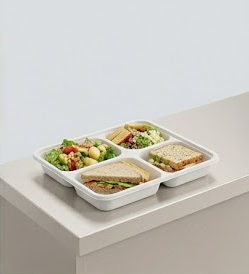
Step into a busy catering kitchen during peak hours and one thing becomes obvious very quickly—packaging is not just packaging. It’s part of the workflow. Trays are stacked, moved, sealed, carried, and sometimes rushed out the door faster than anyone would like.
That’s where the choice between heavy-duty and lightweight starts to matter in a very practical way. Not as a spec sheet comparison, but as a decision that directly affects efficiency, cost, and customer experience. Many buyers only revisit this decision after something goes wrong—warped trays, leaking lids, or inconsistent performance across batches.
Working with a custom compartment tray manufacturer for high-volume catering operations often begins with a simple but critical discussion: what kind of stress will your trays actually go through?
Why One Standard Tray Rarely Fits Every Scenario

It’s tempting to simplify procurement by choosing one tray for everything. On paper, it reduces complexity. In reality, different catering scenarios place very different demands on packaging.
For delivery-focused operations, trays go through multiple handling stages—packing, stacking, transport, and handoff. Movement and pressure are constant. In this case, reliability matters more than anything else, which is why many operators turn to a heavy-duty compartment tray supplier for food delivery chains that can handle these variables without compromising structure.
In contrast, cafeteria-style dining or internal canteens operate in a much more controlled environment. Meals are served and consumed quickly, with minimal transport. Here, using an overbuilt tray doesn’t add value. A lightweight compartment tray manufacturer for cafeteria dining services is often a better fit, helping reduce cost while keeping operations smooth.
Central kitchens introduce another layer. Meals are produced in bulk, sealed, and distributed in batches. Consistency becomes critical, especially when automation is involved. This is where a OEM compartment tray factory for central kitchen meal distribution can provide solutions that align with both equipment and scale.
It’s Not About Thick vs Thin—It’s About Where It Fails
At first glance, the difference between heavy-duty and lightweight trays seems straightforward. One is stronger, the other more economical. But in practice, failures don’t happen because something is “too thin.” They happen because the tray isn’t designed for the conditions it faces.
A tray might look sturdy but still deform slightly under stacking pressure, just enough to loosen the lid. Or compartments may not be deep enough to contain sauces during transport. These are small design mismatches that create bigger operational issues.
That’s why many buyers work with a ODM compartment tray supplier for customized structural solutions, focusing on reinforcing key stress points instead of simply increasing material thickness. In many cases, better design solves the problem without significantly raising cost.
Cost Is More Than the Unit Price
Lightweight trays usually look better on a quotation sheet. Lower material usage, lower cost per unit. But real cost shows up during use.
If trays fail during delivery, the impact isn’t just the packaging—it’s wasted food, refunds, and customer dissatisfaction. These hidden costs accumulate over time. On the other hand, using heavy-duty trays in low-risk scenarios can quietly inflate expenses without delivering real benefits.
This is why experienced buyers often rely on a compartment tray manufacturer for long-term procurement strategies, evaluating how trays perform in actual operations rather than making decisions based purely on upfront pricing.
Materials Matter Less Than You Think—Until They Don’t

Material is usually the first question in any discussion. PP, PET, bagasse—it sounds like a technical choice, but in practice, it’s more about where and how the tray is used.
For hot meals moving quickly from kitchen to service, heat resistance and flexibility tend to be the priority. PP often becomes the practical option here. It doesn’t draw attention, but it performs reliably under pressure, which is exactly what fast-paced kitchens need.
PET appears in a different context. When presentation matters—cold dishes, fresh meals, or grab-and-go displays—clarity becomes part of the product. That’s typically when buyers work with a compartment tray supplier for visually focused food packaging programs to enhance product visibility.
Bagasse usually enters the conversation for sustainability reasons. It works well in controlled settings, but under heavier loads or high moisture, expectations need to be adjusted. Some businesses address this by collaborating with a custom compartment tray manufacturer for eco-conscious catering solutions, refining structure or limiting use to suitable scenarios.
What’s often overlooked is how much design influences performance. Two trays made from the same material can behave very differently depending on their structure. Reinforced edges, base geometry, and compartment depth all play a role.
Material sets the baseline, but structure determines how the tray actually performs.
Where Problems Actually Show Up
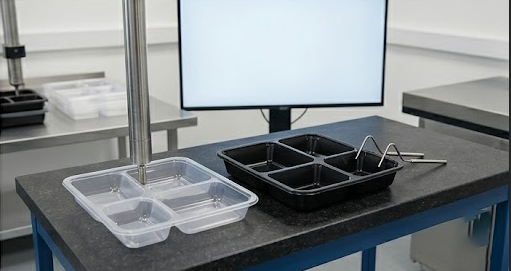
In high-volume catering, issues rarely appear during testing—they show up during peak hours. That’s when trays are stacked higher, packed faster, and handled more roughly than expected.
Under these conditions, even small weaknesses become visible. Lids may not seal properly if the tray deforms. Compartments may allow food to mix if barriers are too low.
To avoid this, many operators work with a compartment tray factory for large-scale catering environments to run practical tests—using real meals, real stacking conditions, and real transport scenarios. It’s a simple step, but it reveals far more than specifications alone.
When Heavy-Duty Becomes the Safer Option
Some situations leave little room for compromise. Meals with multiple components, high moisture content, or longer delivery times place consistent stress on packaging. Add brand expectations into the mix, and consistency becomes even more important.
In these cases, choosing a durable compartment tray supplier for premium foodservice brands is less about over-specifying and more about reducing risk. The goal is stability—ensuring that every meal arrives in the same condition it left the kitchen.
When Lightweight Is the Better Fit
Lightweight trays are not a downgrade—they are a strategic choice. In controlled environments where meals are consumed quickly and handling is minimal, efficiency matters more than structural strength.
They can speed up packing, reduce storage space, and lower overall costs. For many institutions, working with a cost-efficient compartment tray manufacturer for high-volume dining programs provides the right balance between performance and budget.
The key is understanding when you’re optimizing—and when you might be pushing the limits too far.
The Role of a Reliable Supplier
Choosing the right tray is only part of the equation. Consistency in production, stable supply, and the ability to adapt designs over time are just as important.
A dependable partner should not only provide products but also understand the realities of your operation. That’s why many buyers prefer working with a compartment tray manufacturer for scalable food packaging supply, where flexibility and reliability are built into the process.
A Practical Way to Make the Decision
Instead of starting with product categories, start with your workflow. Look at how food moves, where pressure builds, and where things are most likely to fail.
If your operation involves transport, stacking, and time, durability becomes the priority. If it’s controlled, immediate, and predictable, efficiency takes the lead.
Heavy-duty and lightweight trays are not competing options—they solve different problems. The right choice comes down to understanding which problem matters more in your day-to-day operations.