
Let’s be real: swapping out plastic for “green” alternatives is a logistical nightmare if the product fails the moment a customer hits the “start” button on their microwave. We’ve all seen it. You ship out a premium meal, and ten minutes later, the customer is calling because the bowl turned into mush. It’s frustrating. While the shift toward sustainable materials is non-negotiable in today’s market, plant fibers just don’t follow the same rules as petroleum-based plastics. As a professional compostable bowl manufacturer providing custom OEM services, we spend a lot of time in the lab figuring out how to bridge the gap between “eco-friendly” and “actually functional.”
1. The Soggy Bottom Nightmare

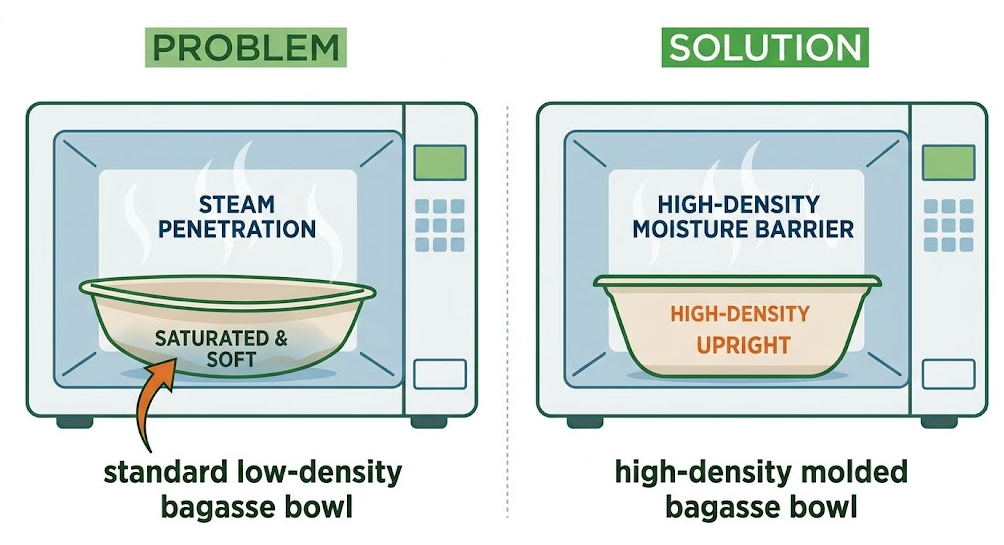
The most frequent complaint we hear from wholesalers is that the bowl loses its backbone during heating. Why? Because materials like sugarcane bagasse are naturally thirsty. When you microwave food, you aren’t just heating the meal; you’re creating a miniature steam room inside that container. In a low-quality bowl, that steam moves straight into the fiber walls. The result? A base that feels like wet cardboard.
This isn’t just an inconvenience; it’s a massive liability for a restaurant. To fight this, you have to look beyond the price tag and check the density. Sourcing from a reliable sugarcane bowl factory with high-density molding technology is the only real fix. By using massive pressure during the molding stage, the fibers are packed so tight that steam simply can’t find a way in. It keeps the bowl rigid, even if the customer is reheating a heavy, liquid-based soup for three or four minutes.
2. The Greasy “Sweat” Effect
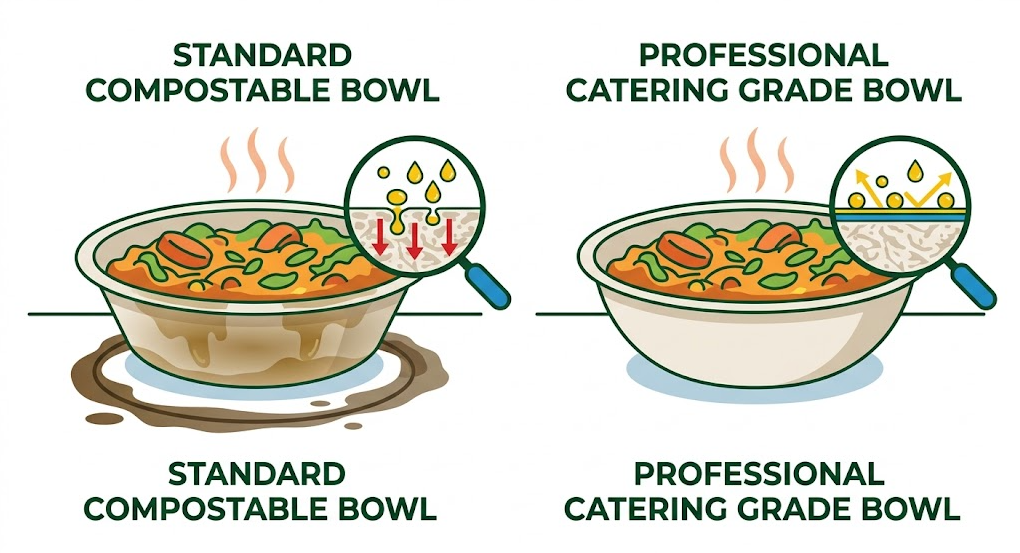
There is a huge difference between being leak-proof on a shelf and being leak-proof in a microwave. We see a lot of B2B buyers get burned here. They buy a container of bowls that look great, but the second hot oil hits the fiber under heat, the bowl starts “sweating” onto the table. It’s a mess. This happens because heat makes oils more fluid, allowing them to slip through the microscopic gaps in the plant fibers.
A specialized eco-friendly bowl supplier for the catering industry tackles this by treating the pulp with food-safe, PFAS-free oil repellents before the bowl is even formed. It’s an internal barrier, not just a surface coating. If your current stock is leaving oily rings on customer desks, your supplier is likely skipping the expensive additives that make fiber truly grease-resistant under thermal stress. In the B2B world, quality is measured by what doesn’t happen—like leaks.
3. Thermal Conductivity: The Finger-Burner Issue

We’ve all experienced the frustration of a container that is scorching hot while the food inside is still lukewarm. Plant fibers are actually pretty good at conducting heat, which is a double-edged sword. Unlike foam, which stays cool to the touch, a thin fiber bowl will transfer heat to a customer’s hands almost instantly. It’s a major safety complaint for takeout heavy-businesses.
To combat this, a leading pulp bowl manufacturer for global wholesale markets designs their products with structural “heatsinks.” This could mean adding a wider rim so there’s a cool place to grab, or designing a base with ridges that reduce the surface area touching the microwave plate. If you aren’t looking at these design specs during procurement, you’re basically handing your customers a heat hazard. Safety is a feature, and it starts with the mold design.
4. The “Farm-Like” Aroma Interference
This is a subtle one, but it ruins the premium feel of a meal. Because these bowls are made from agricultural waste—wheat straw, bamboo, or sugarcane—they carry a natural organic scent. Usually, it’s invisible. But blast it with 1000 watts of microwave energy, and that “earthy” smell wakes up. For a customer eating a delicate pasta or a fresh salad, a faint smell of “wet grass” is a dealbreaker.
The solution is in the refining process. An experienced compostable bowl factory focusing on ODM solutions uses high-heat sterilization and multiple wash cycles to strip away the lignin—the stuff that actually causes that smell. If your packaging smells like a barn when it gets hot, it means the raw pulp wasn’t cleaned properly. For high-end hospitality, having a neutral-smelling container is just as important as the food itself.
5. Structural Delamination During Long Heats
Most compostable bowls are built for a quick 2-minute warm-up. But customers are unpredictable. Some will defrost a frozen meal for 7 minutes at full power. That’s when the “cheap” bowls start to flake. The heat eventually breaks the natural bonds holding the fibers together, and you might even see the material start to peel into the food.
When you’re looking for a reputable compostable bowl supplier for bulk purchase, you have to demand a high heat-deflection rating. You want a product that is officially rated for at least 120 degrees Celsius. Without that thermal stability, the bowl is just a ticking time bomb in the customer’s kitchen. You need a partner who understands that “compostable” shouldn’t mean “weak.”
Picking a Partner That Handles the Heat
Look, the “green” transition shouldn’t be a sacrifice. Your customers shouldn’t have to choose between saving the planet and having a bowl that actually works. The five problems we’ve talked about are almost always a result of cutting corners in the manufacturing process to save a fraction of a cent.
By partnering with a professional compostable bowl factory for high-end hospitality brands, you’re investing in a supply chain that prioritizes material science over bottom-of-the-barrel pricing. You want a bowl that stays stiff, stays dry, stays cool to the touch, and doesn’t smell like a farm. If you can deliver that, the sustainability of your packaging becomes a huge brand asset instead of a liability. When the heat is on, your packaging needs to be the last thing your customer has to worry about.