
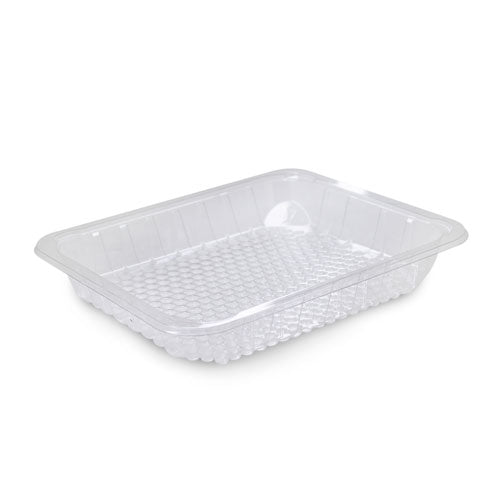
In the U.S. produce market, packaging rarely causes problems when everything goes right. It becomes visible only when something fails—when trays crack in transit, moisture builds up on shelf, or a retailer questions the sustainability claim printed on the label. That is why rPET veggie trays are now treated less as a packaging upgrade and more as a risk-management decision.
For eco-focused brands, the question is no longer whether recycled PET should be used, but which manufacturers can support it without introducing operational or regulatory friction.
rPET Veggie Trays: Practical Reality Versus Marketing Language
Most rPET used in veggie trays originates from post-consumer PET bottles. After sorting and decontamination, the material is processed into food-grade sheet and thermoformed. On a supplier website, this loop often looks clean and uniform. In real supply chains, it is not.
Some trays contain recycled content but still rely heavily on virgin PET to maintain stiffness. Others are produced within systems designed to recycle trays back into trays. The difference matters when brands are asked to justify environmental claims in ESG reporting or retailer reviews. Carbon reduction figures in the 60–70 percent range are widely accepted in the U.S. market because they reflect actual recovery conditions, not idealized models.
This is why buyers increasingly filter suppliers by whether they operate as a food-grade rPET veggie tray manufacturer, rather than by recycled content percentages alone.
Why rPET Fits U.S. Regulation Better Than Most Alternatives
Food-contact compliance remains the non-negotiable baseline. Any rPET veggie tray sold in the U.S. must meet FDA requirements that evaluate the recycling process itself, not just the finished tray. Beyond federal rules, state-level EPR programs are quietly shaping packaging decisions.
Materials that already move smoothly through existing recycling systems tend to face less scrutiny. PET benefits from decades of infrastructure, making rPET trays easier to explain and defend during audits. For brands supplying national retailers, this predictability often outweighs experimental materials that promise compostability but lack recovery at scale.
As a result, rPET veggie trays have become a default choice for brands seeking sustainability improvements without operational disruption.
How Buyers Separate Reliable Suppliers from Risky Ones
Produce packaging fails differently than dry goods packaging. Moisture, temperature swings, and weight stress expose weak designs quickly. Ventilation patterns influence shelf life, while rim geometry affects how trays behave on pallets.
Beyond design, supply reliability plays an outsized role. Domestic manufacturing shortens lead times and simplifies documentation. Flexible tooling and realistic MOQs allow brands to adapt packaging without rewriting contracts. These factors explain why many procurement teams prioritize a custom rPET veggie tray manufacturer that understands produce behavior, not just polymer performance.
1. Cascades: Circular Systems at Retail Scale

Cascades approaches rPET veggie trays as part of a broader circular model. Its tray-to-tray recycling programs appeal to large produce brands that need measurable outcomes rather than symbolic sustainability.
In distribution, Cascades’ reinforced designs hold up under pallet loads, reducing transit failures. For high-volume programs, Cascades often functions as an industrial rPET veggie tray supplier for national retailers, although its scale can limit customization speed.
2. NNZ USA: Designing Around the Vegetable, Not the Tray
NNZ USA treats rPET veggie trays as agricultural tools rather than generic containers. Tray depth and airflow are engineered around how specific vegetables respire and dehydrate.
This approach tends to reduce shrink and condensation during transport. Brands with sensitive produce often rely on NNZ as an OEM rPET veggie tray manufacturer because the designs are grounded in handling realities, not catalog convenience.
3. Placon: Predictability Through Material Control
Placon controls its own rPET sheet production, which reduces variability across runs. Its Ecostar material delivers clarity and rigidity close to virgin PET.
For brands operating across multiple regions, this consistency reduces retail rejections and audit questions. Placon is frequently selected as a rPET veggie tray manufacturer for U.S. retailers that expect uniform packaging year-round.
4. Naturpac: rPET for Brands That Lead With ESG
Naturpac targets produce brands that treat packaging as part of their public sustainability narrative. Its rPET veggie trays emphasize traceable sourcing and structural features that protect product integrity.
Pricing reflects that focus, but for certain segments Naturpac fills the role of a sustainable rPET veggie tray supplier for organic brands, where credibility matters more than cost minimization.
5. Go Green Food Packaging: Broad Coverage Over Specialization
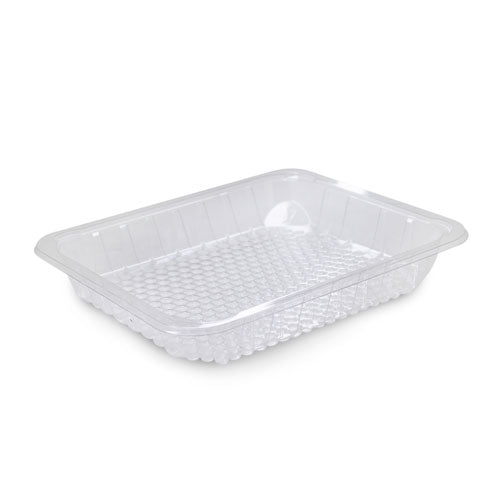
Go Green Food Packaging supports vegetables alongside other fresh foods using rPET and CPET formats. This breadth simplifies sourcing for distributors managing mixed categories.
Nested designs help lower logistics costs, even if produce-specific engineering is less pronounced. In practice, Go Green operates as a multi-category rPET veggie tray supplier rather than a specialist.
6. Packform USA: One Platform for Fresh and Frozen
Packform USA LLC addresses the growing overlap between fresh-cut and frozen vegetables. Its rPET and CPET trays handle cold storage and reheating without switching suppliers.
This versatility positions Packform as a rPET veggie tray factory for fresh and frozen lines, particularly for brands expanding across temperature-controlled segments.
7. Inline Plastics: When Shelf Appearance Drives Choice
Inline Plastics emphasizes clarity and presentation. Its rPET veggie trays are designed to showcase freshness while remaining recyclable and food safe.
For brands selling in visually competitive retail environments, Inline Plastics often acts as a clear rPET veggie tray manufacturer for wholesale distribution with established shelf acceptance.
8. Pactiv Evergreen: Supply Continuity at National Scale
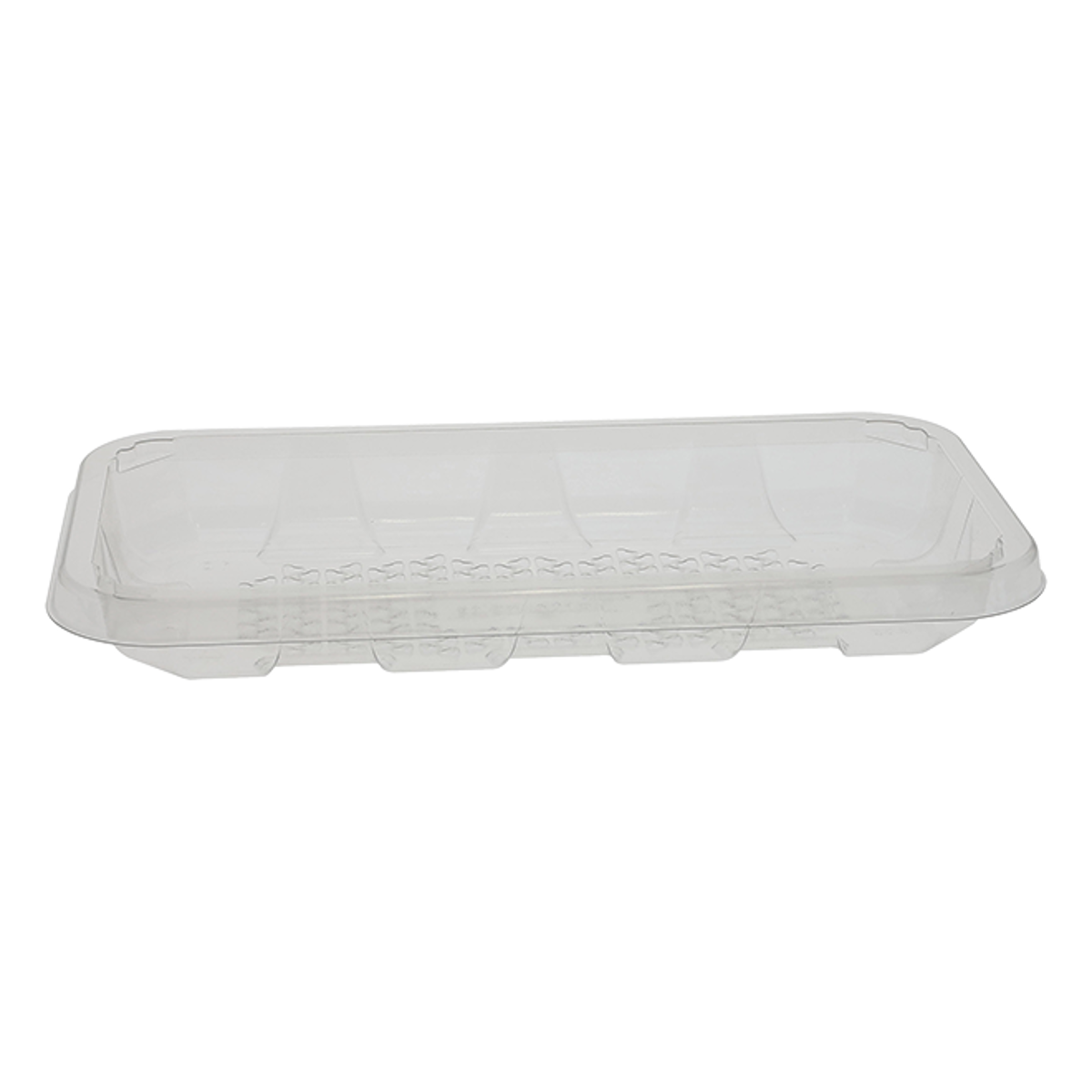
Pactiv Evergreen focuses on supply stability rather than customization. Its rPET produce trays support national programs where interruptions carry high commercial risk.
Large brands frequently rely on Pactiv Evergreen as an rPET veggie tray supplier for large brands, valuing continuity over bespoke design.
Closing Perspective on rPET Veggie Tray Selection
As sustainability expectations harden into formal requirements, rPET veggie trays are becoming standard rather than optional. The manufacturers discussed here approach the market from different angles, but all reflect the same reality: packaging decisions now influence compliance, logistics, and brand perception at once.
For eco-focused brands, the most resilient choice is rarely the cheapest tray. It is the partner whose material control, documentation, and production discipline align with how produce actually moves through the U.S. market. In that sense, selecting an rPET veggie tray supplier is no longer a packaging decision—it is a strategic one.