
If you think making professional-grade ice cream is just about perfecting a recipe in a small batch freezer, you’re missing half the picture. The real challenge—the one that separates the hobbyists from the profitable B2B brands—is how that ice cream behaves once it hits the container. Moving from a soft-serve consistency to a hard-pack retail product involves complex thermodynamics and structural physics. If you don’t understand how your mix interacts with a paper vessel, you are essentially gambling with your inventory.
Managing the “Shrinkage” Phenomenon During Hardening

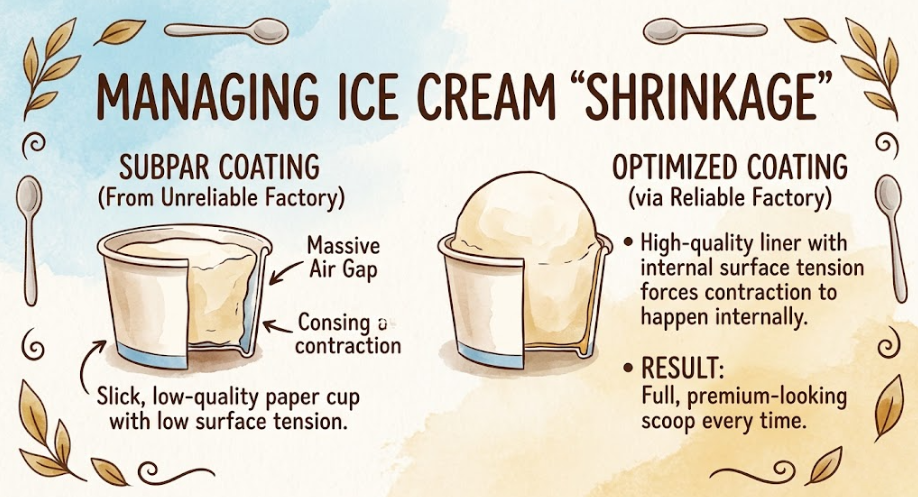
One of the most frustrating sights in production is opening a hardened pint only to see a massive air gap between the ice cream and the cup wall. In the industry, we call this “shrinkage.” It happens because ice cream naturally contracts as it freezes, but if your cup surface is too slick or low-quality, the mix won’t “grab” the sides. To fix this, you need a reliable paper ice cream cup factory for B2B procurement that produces cups with the right internal surface tension. A quality lining ensures that the ice cream adheres to the walls, forcing the contraction to happen internally rather than pulling away from the edges. This results in a full, premium-looking scoop every single time the customer pops the lid.
Preserving Overrun Under Mechanical Pressure
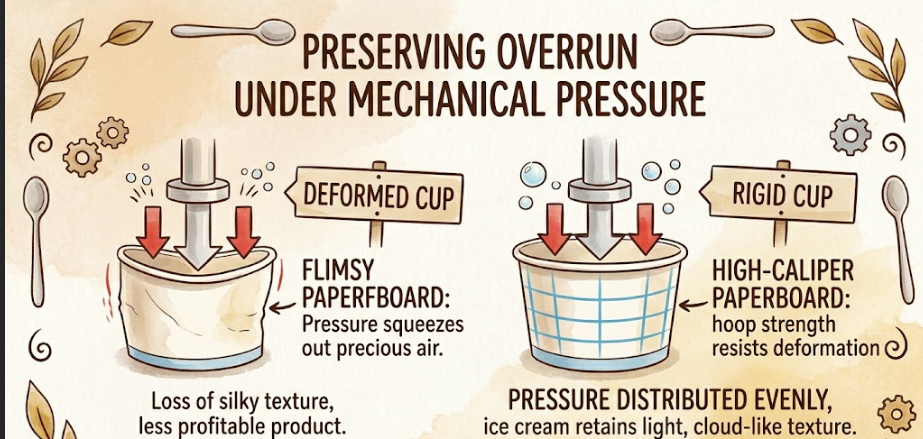
The “overrun”—that beautiful air you’ve whipped into your mix to create a silky mouthfeel—is incredibly fragile. During automated filling, the piston pressure can actually “squeeze” the air out of the mix if the cup doesn’t hold its shape. If your cups are flimsy, they flex under the filling head, destroying the aeration you worked so hard to achieve. This is why savvy operators insist on working with a top-tier paper ice cream cup supplier for international trade. You need high-caliper paperboard that provides enough “hoop strength” to resist deformation. When the cup stays rigid, the pressure is distributed evenly, and your ice cream retains that light, cloud-like texture that customers pay a premium for.
Defeating the “Ice Crystal” Texture
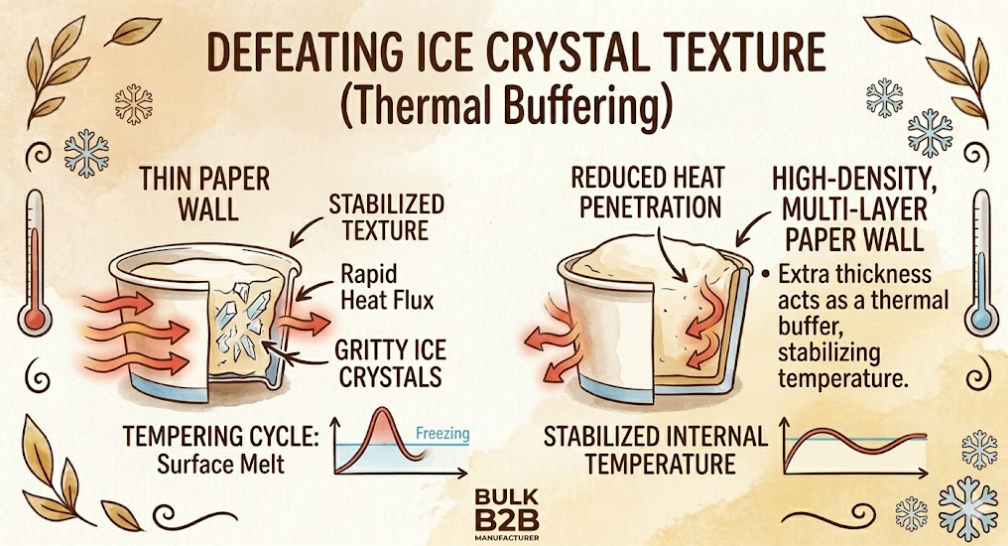
Ever wonder why some ice cream stays smooth for months while others turn into a gritty, icy mess? It’s often a packaging failure. Paper is a natural insulator, which is both a blessing and a curse. If the cup wall is too thin, every time a freezer door opens, a tiny amount of heat penetrates the cup, causing the surface to melt and then re-freeze into large ice crystals. By sourcing from a professional ice cream cup manufacturer for bulk buyers, you can specify higher-density paper walls. This extra thickness acts as a thermal buffer, stabilizing the internal temperature during the “tempering” cycles of transport and storage. It’s the simplest way to extend your shelf life without adding chemical stabilizers to your clean-label recipe.
Eliminating Off-Flavors from Subpar Materials
Ice cream is essentially a fat-based sponge; it absorbs odors and flavors from its environment with terrifying efficiency. If you use cheap paper cups made with low-grade pulp or non-food-grade inks, that “cardboard” taste will leach into your delicate cream. This is a nightmare for high-end brands using expensive ingredients. To prevent this, you should partner with a dedicated custom ice cream cup factory that uses virgin wood pulp and soy-based, low-migration inks. The container should be invisible to the palate. Your goal is for the customer to taste the vanilla bean, not the packaging material it was stored in.
Future-Proofing for the Plastic-Free Era
Let’s be realistic: the regulatory landscape for single-use plastics is shifting under our feet. If you’re planning to scale, you can’t ignore the move toward sustainability. Traditional PE-lined cups are already being restricted in several global markets. Transitioning to aqueous (water-based) coatings or PLA-lined options is a technical hurdle because these materials freeze differently. Finding a sustainable ice cream cup supplier for global chains early on allows you to run “stress tests” on these eco-friendly materials. You need to know if the biodegradable coating will hold up for six months in a deep freeze before you commit your entire brand to it.
The Engineering of the “Perfect Seal”
The most critical part of your packaging isn’t the bottom—it’s the rim. If the rolled bead at the top of the cup isn’t perfectly consistent, your lids won’t create an airtight seal. This leads to “freezer burn,” where the dry air of the freezer sucks the moisture out of the top layer of your ice cream, leaving a chewy, discolored crust. When auditing an OEM ice cream cup factory for franchise brands, you have to inspect their rim-forming machinery. You want a tight, uniform roll that provides that satisfying “snap” when the lid is applied. That snap is the sound of moisture being locked in and air being locked out.
Why Supply Chain Consistency Trumps Unit Cost
The final practical tip isn’t about physics—it’s about business survival. In the B2B world, the “cheapest” cup is usually the one that shows up on time and doesn’t jam your filling line. If you save two cents per cup but lose a whole day of production because of a bad batch of de-nesters, you’ve lost money. Building a relationship with a leading paper ice cream cup supplier for long-term partnership gives you a safety net. You need a partner who understands your production peaks in the summer and keeps a buffer of your custom inventory ready to ship.
Conclusion: Packaging as a Culinary Tool
At the end of the day, making ice cream with paper cups is an extension of the culinary process. The cup is the final “ingredient” that ensures your hard work reaches the consumer in peak condition. By focusing on surface tension, thermal insulation, and seal integrity, you turn a simple paper vessel into a sophisticated preservation tool. Don’t let your recipe be let down by your packaging; invest in the science of the cup, and your brand will reap the rewards in the freezer aisle.