
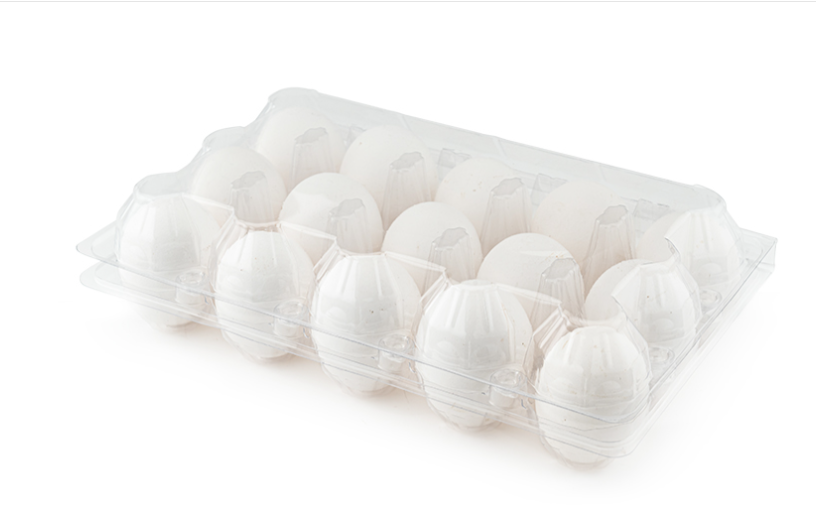
People often assume the question “how many eggs are in a tray” has a simple, almost trivial answer. In commercial egg handling, however, that number is not just a count. It is a decision shaped by transport limits, labor efficiency, packaging economics, and breakage risk accumulated over decades of trial and error.
In most professional supply chains, the answer is 30 eggs per tray. This figure appears so consistently across farms, warehouses, and wholesale markets that it feels self-evident. Yet the reason it became standard is less obvious than many expect.
What the Industry Actually Means by “One Egg Tray”

When buyers, farmers, or logistics managers refer to “a tray,” they are rarely thinking in abstract terms. They are referring to a specific physical object designed to move eggs safely through multiple handling stages. In this context, a tray holding 30 eggs is not simply common—it is assumed.
The typical configuration places eggs in a five-by-six arrangement, with each egg seated in its own molded pocket. This layout has been repeated millions of times across pulp, plastic, and foam trays, not because it looks neat, but because it works reliably under pressure, vibration, and stacking loads.
If someone in the industry says a shipment contains “200 trays,” the implicit understanding is that each tray holds 30 eggs unless stated otherwise.
Why 30 Eggs Survived While Other Capacities Did Not
Over the years, producers experimented with many tray sizes. Smaller formats reduced weight but increased handling steps. Larger formats improved density but introduced instability. What eventually mattered was not theoretical efficiency, but what survived daily use.
A tray filled with 30 eggs stays within a weight range that workers can lift repeatedly without excessive fatigue. It is heavy enough to remain stable when stacked, yet light enough to avoid deformation in pulp or thin plastic designs. That balance turned out to be more important than squeezing in extra eggs.
Another factor is alignment. Thirty eggs fit neatly into outer cartons and onto pallets without wasted space. Once transport systems adapted to this geometry, deviating from it created more problems than benefits.
Is the 30-Egg Tray Truly Global?

Despite its dominance, the 30-egg tray is not the only format in use. Retail environments often favor smaller packs, particularly where consumer handling matters more than transport efficiency. In the United States, shoppers are most familiar with 12-egg cartons, even though farms continue to rely on 30-egg trays behind the scenes.
European markets show similar patterns, with occasional use of 20-egg retail packs. In parts of Asia, higher-capacity trays appear in farm-internal movement, especially where eggs travel short distances before grading.
Still, when eggs move beyond local distribution—into wholesale, cold storage, or export—the system consistently returns to 30 eggs per tray. No other capacity has proven as adaptable across borders.
Smaller and Larger Trays: Why They Remain Niche Options
Trays holding 12, 18, or 24 eggs exist primarily for presentation and convenience. They are designed to be carried by consumers, displayed on shelves, and opened easily. From a logistics perspective, they are inefficient. More units are required to move the same volume, increasing labor and packaging costs.
At the other extreme, trays holding 36 or even 60 eggs attempt to maximize density. These designs reduce the number of trays in circulation but introduce new risks. As capacity increases, the structural demands rise sharply. Slight warping or uneven stacking can cause eggs to press against each other, dramatically increasing breakage rates.
For long-distance transport, especially where vibration and repeated handling occur, these larger formats rarely justify their theoretical efficiency gains.
Physical Reality of a Standard 30-Egg Tray

There is no single blueprint shared by all manufacturers, but standard 30-egg trays converge around similar proportions. The outer dimensions are dictated less by tradition and more by compatibility with cartons, pallets, and automated equipment.
Strength comes from structure rather than bulk. Rib placement, pocket depth, and wall thickness determine how well a tray distributes load. Two trays with identical dimensions can perform very differently depending on these design details.
Material choice further complicates comparisons. Molded pulp trays prioritize light weight and disposability. Plastic trays emphasize durability and reuse. EPS trays provide excellent cushioning but face regulatory and sustainability challenges in some regions. Each material interacts differently with the same 30-egg geometry.
How Tray Design Actually Protects Eggs
Egg trays do not protect eggs by immobilizing them completely. Instead, they manage force. Each egg rests in a shaped cavity that limits contact with its neighbors. When vertical pressure is applied, the load transfers through the tray’s structure rather than directly onto the shell.
During transport, the greatest threat is not static weight but motion. Vibration, sudden stops, and uneven roads introduce dynamic forces that amplify stress. Well-designed trays flex slightly, absorbing energy that would otherwise crack shells.
This is where standardization matters. A design refined for 30 eggs has been tested repeatedly in real conditions. Improvised or oversized designs lack this accumulated validation.
Stackability: The Hidden Advantage of Standard Capacity
One reason the 30-egg tray persists is how well it stacks. Standard trays are engineered to align vertically, reducing lateral movement. This interlocking behavior prevents trays from sliding and concentrates load paths where the structure is strongest.
Stacking limits depend on material. Plastic trays tolerate higher stacks due to rigidity. Pulp trays require more conservative limits but still perform predictably when used within design parameters. In cold storage, consistent spacing also allows airflow to circulate evenly, reducing temperature gradients.
These stacking behaviors are not accidental. They evolved alongside the 30-egg format and reinforce its practicality.
Hygiene and Regulatory Pressures
Food safety concerns increasingly influence tray selection. Disposable pulp trays are often chosen for export because they reduce contamination risk and simplify compliance. Reusable plastic trays demand controlled washing and sanitation procedures, adding operational complexity.
In regulated markets, buyers often prioritize documented compliance over marginal savings. A tray that meets hygiene expectations consistently is more valuable than a cheaper alternative that introduces uncertainty.
Durability Versus Real Cost
Reusable trays are frequently marketed as more economical due to their long lifespan. In practice, durability alone does not determine cost. Each reuse cycle requires collection, cleaning, inspection, and redistribution. Damage accumulates gradually, and replacement is inevitable.
Disposable trays eliminate these steps. While they have a shorter lifespan, they also simplify logistics. When costs are evaluated over time rather than per unit, disposable 30-egg trays often remain competitive, particularly in export-oriented operations.
Choosing the Right Tray for Different Operations
Tray selection should reflect how eggs move through a specific business, not abstract standards. Small farms with limited output often favor lightweight, single-use trays that reduce handling complexity. Larger producers may invest in reusable systems if their logistics support controlled circulation.
Retail packaging demands smaller capacities for consumer convenience, but wholesale and export channels continue to depend on the 30-egg tray. Sustainability goals further influence decisions, with biodegradable materials gaining attention where regulations tighten.
What matters is not whether alternatives exist, but why the industry repeatedly returns to the same solution. After decades of adjustment, 30 eggs per tray remains the most reliable compromise between protection, efficiency, and cost.