
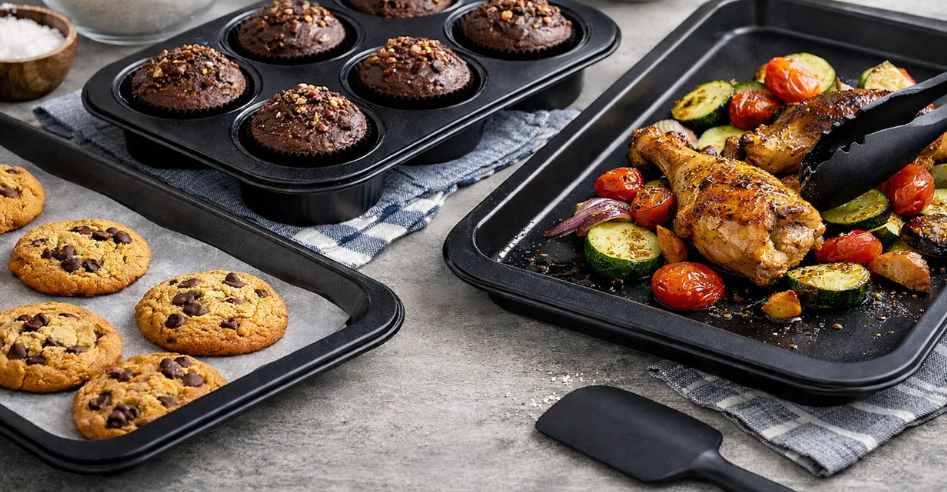
In commercial baking environments, heat is rarely theoretical. Ovens run hot, cycles repeat without long cooling periods, and trays are expected to perform the same way on day one and day five hundred. Under those conditions, the safety of Non-Stick Baking Trays stops being an abstract materials question and becomes a practical sourcing issue.
For buyers evaluating products from a non-stick baking tray manufacturer, the concern is not whether non-stick surfaces work. The concern is what happens when those surfaces are pushed close to their limits, again and again.
Why High Heat Changes the Conversation

At moderate temperatures, most trays behave predictably. The real differences only appear once heat exposure becomes routine rather than occasional. This is where assumptions start to break down.
In real kitchens, trays are rarely used “by the book.” Empty preheating happens. Broil settings are used as shortcuts. Ovens overshoot their set temperature. From the perspective of a non-stick baking tray supplier for commercial kitchens, none of this is surprising—and all of it affects long-term safety.
High heat does not usually cause immediate failure. What it does is remove margin. Coatings lose tolerance. Steel expands unevenly. Minor surface damage stops being cosmetic and starts to matter.
How Non-Stick Baking Trays Are Typically Constructed
Why Carbon Steel Is the Default Choice
Most professional Non-Stick Baking Trays are built on carbon steel. There is a reason nearly every carbon steel baking tray factory serving bakeries and foodservice relies on it.
Carbon steel stays rigid under heat. It does not soften at baking temperatures, and it tolerates repeated expansion and contraction better than lighter metals. From a food-contact standpoint, it is also chemically stable. When safety questions arise, they almost never start with the steel itself.
Where Non-Stick Performance Actually Comes From
Non-stick behavior is defined at the surface, not the core. A non-stick baking tray OEM may offer multiple surface options depending on use case.
PTFE coatings deliver consistent release but require strict temperature control. Ceramic systems handle short heat spikes but wear faster over time. Anodized finishes change the metal surface itself, trading release performance for durability.
For buyers working with a non-stick baking tray supplier for private label programs, the key is not choosing the “best” coating, but choosing the right one for how the tray will actually be used.
Temperature Ratings: What They Do — and Do Not — Tell You

The Numbers Buyers See
Most Non-Stick Baking Trays are rated somewhere between 425°F and 475°F for continuous use. These figures are tied to coating stability, not structural strength.
A professional baking tray manufacturer may list higher maximum temperatures, but those numbers often apply to bare steel versions rather than coated products.
Why Coated and Uncoated Trays Cannot Be Treated the Same
Bare carbon steel can tolerate very high temperatures without concern. Coated trays cannot. This difference is often ignored in mixed-use kitchens, where the same tray is expected to handle cookies one day and pizza the next.
For a non-stick baking tray supplier for pizza ovens, this mismatch explains a large percentage of early coating failures.
What Overheating Looks Like Over Time
When trays exceed their limits, failure is rarely dramatic. Smoke appears first. Odors follow. The surface becomes harder to clean. None of these signal immediate danger, but together they indicate chemical breakdown and reduced safety margin.
Heat Behavior, Thickness, and Physical Stability
Carbon Steel Heats Fast — That Cuts Both Ways
Carbon steel responds quickly to heat. Compared with stainless steel, it reaches baking temperature faster. Compared with aluminum, it stays stiff.
For a baking tray manufacturer for high-temperature use, this responsiveness improves performance but reduces forgiveness. Mistakes happen faster.
Thickness Is a Safety Variable
Thin trays heat unevenly. Hot spots form near edges and corners. Thicker trays absorb and spread heat more evenly, protecting coatings from localized stress.
When buyers work directly with a non-stick baking tray factory, gauge thickness is one of the few specifications that reliably improves both performance and safety.
Warping Is Not Just a Performance Issue
Warping is usually the result of uneven heating or rapid temperature changes. Once a tray warps, heat distribution becomes unpredictable. Local temperatures rise. Coatings degrade faster.
From a sourcing perspective, this is not just about appearance—it directly affects safe operating conditions.
Chemical Stability Under High-Temperature Baking

What Actually Moves — and What Does Not
Iron-based materials remain stable at baking temperatures. Migration concerns focus on coatings rather than carbon steel.
This is why evaluations by a non-stick baking tray supplier for foodservice buyers center on surface behavior, not base metal composition.
Aging Happens Gradually
Coatings are designed for repeated use, but only within defined limits. When those limits are exceeded regularly, degradation becomes cumulative. Durability drops first. Safety margin follows.
Acidic Foods Add Stress
Acidic ingredients accelerate surface wear, especially when combined with high heat. This does not instantly create a hazard, but it shortens coating life and increases replacement frequency.
Seasoning as a Different Approach
Some operations avoid coatings altogether and rely on seasoned carbon steel. Seasoning forms a polymerized oil layer that provides release without synthetic materials.
For a carbon steel baking tray supplier for artisan bakeries, this approach works well at high temperatures. The trade-off is consistency. Seasoning quality depends heavily on handling discipline, oil choice, and temperature control.
How Non-Stick Baking Trays Compare With Other Materials
Above 475°F, material differences become obvious. Carbon steel and cast iron remain stable. Stainless steel stays safe but reacts slowly. Aluminum loses rigidity. Ceramic results vary widely.
From a risk standpoint, bare carbon steel offers one of the widest safety margins at extreme heat. Coated trays perform well when temperature control is reliable.
Different tasks demand different priorities. Pizza and hearth bread favor steel. Delicate pastries benefit from controlled non-stick surfaces. Heavy roasting demands mass and rigidity.
Use Practices That Matter More Than Marketing
Safe use is rarely about labels. Avoid empty-pan preheating for coated trays. Respect rated temperatures. Allow gradual cooling. Use appropriate utensils.
For buyers sourcing from a non-stick baking tray supplier for commercial baking operations, consistent handling procedures often reduce safety issues more effectively than changing materials.
Final Judgment
Non-Stick Baking Trays are not unsafe by default, even at high temperatures. Problems arise when trays are used outside their intended range or specified incorrectly for the application.
For procurement teams working with a non-stick baking tray manufacturer, safety depends on understanding coating limits, tray thickness, and real operating conditions. When those factors align, non-stick trays can perform safely and reliably in demanding, high-heat environments.